
The Epic CMS Wars: The Mambo Hijack, The Joomla Revolt, and Why WordPress Won Despite Drupal Being Superior
Today, whenever someone wants to launch a website, they invariably hear the same advice: “Just install  WordPress and you’re done.” The fact that a single software platform powers more than 43% of the entire World Wide Web might seem like a smooth, inevitable triumph. Yet behind this reality lies an extraordinary history: early portals adapted from forum engines, a greedy corporate coup attempt against open source, the rebellious birth of
  Joomla!, and the dramatic paradox of how the architecturally superior
  Drupal was eclipsed by sheer usability.
Let’s open the most dramatic, cutthroat chapters of web technology history.
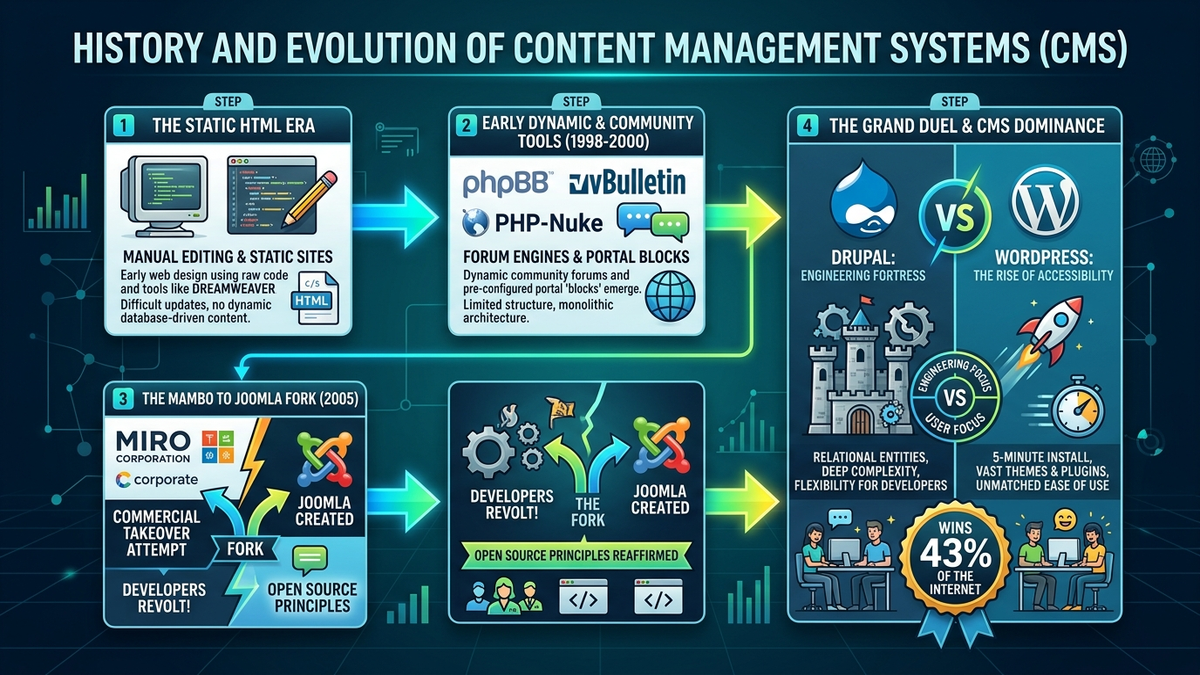
1. The Fundamental Question: What Does "CMS" Actually Mean?
CMS stands for Content Management System.
In the late 1990s, managing a website was pure drudgery. If your website had 500 pages, there were literally 500 separate .html files on the web server. Whenever you needed to add a single menu link across the header, you had to launch Dreamweaver or FrontPage, edit all 500 files one by one, and painstakingly FTP them back to the server.
To eliminate this madness, a brilliant paradigm shift emerged:
- Keep the design template (HTML/CSS) in one unified place,
- Store articles, blog posts, and data in a relational database (MySQL),
- The moment a visitor visits a URL, a server-side programming language (PHP) fetches the text from the database, injects it into the template, and compiles the web page dynamically on the fly.
Administrators received an authentication panel with a Word-style rich text editor—no coding, no FTP uploads required. This architectural breakthrough was christened the CMS.
2. The Ancestors: Forums and the Nuke Portal Era
The earliest dynamic websites were not purpose-built CMSs; they were forum engines ( phpBB, vBulletin). Enthusiasts wrote small add-ons to pull recent forum threads onto the index page, inventing the first community news portals.
Then arrived the legendary  PHP-Nuke (1998–2000). Authored by Francisco Burzi, it codified web layouts for the next fifteen years:
Left column blocks, right column blocks, and a center content feed!
PHP-Nuke (1998–2000). Authored by Francisco Burzi, it codified web layouts for the next fifteen years:
Left column blocks, right column blocks, and a center content feed!
Gaming clans, tech portals, and download repositories were universally powered by PHP-Nuke. However, its codebase was plagued by catastrophic security vulnerabilities. When virtually every PHP-Nuke installation on the internet became vulnerable to SQL injection, it was forced to yield the throne to modern engines.
3. The Mambo Hijack & The Joomla! Revolt: Who Was the Villain, Who Was the Hero?
By the early 2000s, the most polished, awarded, and stylish open-source CMS was unquestionably  Mambo. The global developer community loved it.
Mambo's corporate sponsor and trademark holder was an Australian enterprise named Miro. As Mambo reached immense global popularity, Miro’s executives hatched a scheme:
“We built the brand, and it now powers hundreds of thousands of websites. Let’s seize centralized control. We’ll establish a private Mambo Foundation, subordinate the codebase to our corporate agenda, and commercialize it for profit.”
The Developers' Historic Retaliation
Miro assumed the volunteer developers would quietly obey corporate directives. Instead, the core engineering team who had volunteered years of their lives (led by Andrew Eddie) recognized the hostile takeover immediately.
In August 2005, the entire core development team resigned en masse, published an open manifesto, and forked the codebase. Defying Miro’s PR attacks and legal threats, they rallied under a new flag: Joomla! (derived from the Swahili word Jumla, meaning “all together” or “as a whole”), forming the independent Open Source Matters organization.
What happened next?
Miro paid the ultimate price for its greed. Deprived of developers, community trust, and momentum, Mambo withered away and was defunct within a few years. Meanwhile, Joomla! exploded into the undisputed dominant CMS of the mid-2000s.
Yet Joomla would later struggle with its own demons: brutal backward-incompatibility between major versions (the painful 1.0 to 1.5 and 2.5 transitions), bloated menus, and a commercialized plugin ecosystem that opened the gates for an even fiercer rival.
4. The Grand Duel: If Drupal Was Far Superior, How Did WordPress Conquer the World?
Here lies the greatest paradox in web technology…
Drupal: The Fortress of Pure Engineering
Created in 2000 by Belgian student Dries Buytaert as a dorm message board (Drop.org $ ightarrow$ Drupal, from the Dutch word druppel meaning drop), Drupal was never merely a blogging engine. It was built from the ground up as an enterprise-grade data modeling framework.
- Node & Entity Architecture: An unmatched, modular way to model relational content, custom fields, and taxonomies.
- Views: The ability to query, filter, and render any database records into dynamic grids, feeds, and tables without touching SQL.
- Fortress Security: Adopted by the White House (WhiteHouse.gov), NASA, Oxford, Cambridge, and international governments. Drupal was an impregnable architectural fortress.
Why Isn't Everyone Using Drupal?
Because Drupal was unforgiving, deeply complex, and intimidating!
Mastering Drupal demanded an understanding of relational data models, hook lifecycles, and architecture. Building a simple image gallery required configuring Entity References, Taxonomy terms, and custom Views displays. When you made an error, Drupal gave you the terrifying White Screen of Death.
WordPress: The Triumph of Human Convenience
When Matt Mullenweg and Mike Little forked b2/cafelog in 2003 to create WordPress, their codebase was far from an engineering masterpiece. In fact, its database schemas were rudimentary and full of monolithic queries.
Yet WordPress understood human psychology infinitely better than any engineer:
- The Famous 5-Minute Install: Upload files, enter database credentials, click proceed. Your website is live in 180 seconds!
- No-Code Marketplace: Install stunning themes with a single click. Need a contact form or an SEO helper? Search the repository, hit “Activate”, done.
- The Agency Superpower: Freelancers and agencies could deliver complete client websites in a single afternoon. Doing the exact same task in Drupal took two weeks of custom development.
History proved once again: In software adoption, the winner is rarely the platform with the most sophisticated engineering—it is the one that removes friction and empowers everyday users.
Summary Comparison
| CMS | Identity | Greatest Strength | Critical Weakness | Current Legacy |
|---|---|---|---|---|
|
The Portal Pioneer | Invented the classic 3-column block layout | Disastrous security vulnerabilities | Museum relic |
|
Corporate Casualty | Sleekest early open-source interface | Miro's commercial hijacking attempt | Extinct |
|
Child of the Rebellion | Massive global community, modular power | Painful major migration breakages | Active, but declining market share |
|
Engineering Fortress | Unmatched data architecture, security, scalability | Steep learning curve, requires senior talent | The gold standard for enterprise & gov |
|
The People's King | 5-minute setup, vast theme & plugin ecosystem | Plugin bloat, security sprawl, maintenance overhead | Powers 43%+ of the entire web |
Looking back across this epic history: Had Miro not attempted to monopolize Mambo, Joomla! might never have existed. Had Drupal prioritized everyday usability over pure architectural purity, WordPress might never have enjoyed its unchallenged monopoly.
That is the beauty of the web: History is not written by the cleanest code, but by the software that empowers human beings the fastest!