
What Is MPEG? If There Is 1, 2, and 4, Where Did 3 Go? The Hilarious Reality of MP3 and Codecs
In digital technology, there is a legendary assumption that almost everyone takes for granted: “Since  MP4 is video, surely
  MP3 is simply the audio version from the previous generation,
  MPEG-3, right?”
Not at all. In fact, digging into the true history reveals bureaucratic committee mishaps, ghost projects abandoned mid-way, Italian engineers doing $1 + 2 + 4 = 7$ math, greedy patent pools, and an open-source rebellion that shook the multimedia industry.
Let’s unravel the fascinating journey of digital media from 1988 to today.
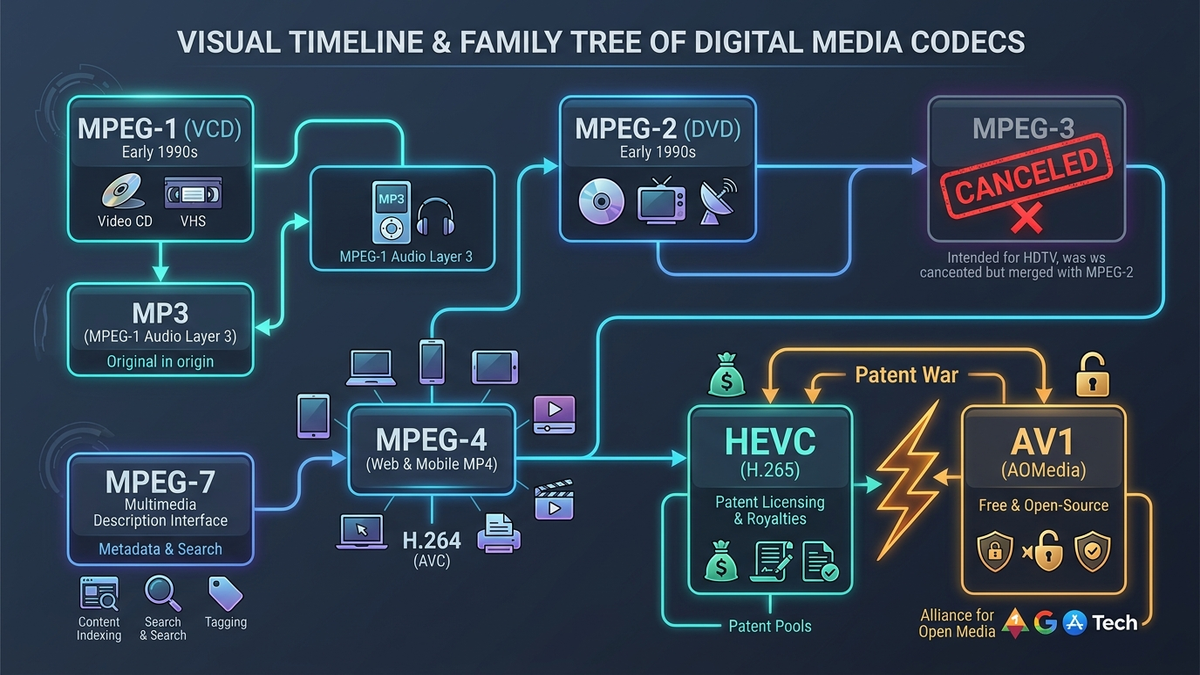
1. How It All Started: What Is MPEG?
In the late 1980s, the computing world was eager to digitize video and sound. There was just one massive roadblock: uncompressed analog media converted to raw digital bits resulted in colossal file sizes that no floppy disk, CD-ROM, or telephone wire could handle.
To solve this, international standards bodies (ISO and IEC) formed a dedicated working group in 1988: the Moving Picture Experts Group (MPEG). Their mission: discard visual and auditory frequencies imperceptible to humans (lossy compression) to squeeze video and audio into compact, transmittable containers.
2. The Pioneers:  MPEG-1 and
  MPEG-2
The team started with two baseline projects:
- MPEG-1 (1993): Designed for standard CD-ROM transfer speeds (1.5 Mbps). Running at 352x240 resolution, it brought the Video CD (VCD) revolution, delivering VHS-grade video on compact discs.
- MPEG-2 (1995):
 While VCD was exciting, broadcast television and film demanded far higher fidelity. MPEG-2 introduced interlaced scanning support, higher bitrates, and pristine quality—powering the global DVD industry and digital satellite TV (DVB).
3. The Big Mystery: What Happened to MPEG-3?
Around that time, the committee chartered their next ambition: MPEG-3.
Its objective was clear: create an independent compression standard tailored specifically for the future of broadcasting: HDTV (High Definition Television - 1080i / 720p).
However, during development, an unexpected realization struck the researchers: The engineers behind MPEG-2 had done their job too well!
Thanks to the modular “Profiles and Levels” architecture of MPEG-2, simply adjusting its high-profile parameters allowed it to seamlessly handle full HDTV resolutions and high bitrates without breaking a sweat. The committee convened and reached a historic verdict:
“MPEG-2 already handles HDTV effortlessly. There is zero justification for building a separate standard, duplicating budgets, and fragmenting the industry. Project 3 is terminated.”
MPEG-3 was quietly shelved and never officially released.
Why didn't they rename the next project to MPEG-3?
This is where technical bureaucracy meets comedy. In standard-setting bodies, projects are initiated in parallel, not sequentially. Project folder #4 ( MPEG-4) had already been chartered, referenced in academic literature, and backed by partner agreements. When Project 3 was killed, nobody bothered to decrement #4. Number 3 remained a permanent ghost, and the world stepped straight into MPEG-4.
4. So What on Earth Is " MP3"?
This is where common intuition gets thoroughly confused. Most people reason:
“MP4 is video, so MP3 must be MPEG-3 audio!”
Absolutely false.
- MPEG-3: An aborted video standard intended for HDTV.
- MP3: Stands for MPEG-1 Audio Layer III—the third audio layer of 1993’s humble MPEG-1 standard!
When MPEG-1 was defined, it included three audio compression tiers: Layer I, Layer II, and the highly sophisticated Layer III. Researchers at Germany’s Fraunhofer Institute voted internally in July 1995 to adopt the file extension .mp3 for their Layer III streams.
When  Winamp, Napster, and portable players exploded—followed years later by MPEG-4 (
.mp4)—the public naturally concluded they were sequential versions of the same technology!
5. Skipping MPEG-6: A Committee Doing Creative Arithmetic
Skipping 3 was just the warm-up. The numbering eccentricity continued:
- MPEG-4 (1998): Built for the internet, mobile devices, and interactive streaming. DivX, Xvid, and modern web codecs emerged from this foundation.
So where were MPEG-5 and MPEG-6? The group’s next objective was not compression, but multimedia content indexing and metadata description. Ebullient Italian chairman Leonardo Chiariglione and his colleagues reasoned:
“This framework describes and encloses all previous standards. MPEG-1 (1) + MPEG-2 (2) + MPEG-4 (4) = MPEG-7!”
Yes: $1 + 2 + 4 = 7$. They skipped straight to MPEG-7, wiping 5 and 6 off the agenda.
Shortly after, when drafting digital rights and multimedia distribution frameworks, they announced: “As we enter the 21st century, let’s call this MPEG-21!”
Creating an absurd chronology:
MPEG-1 → MPEG-2 → (no 3) → MPEG-4 → (no 5) → (no 6) → MPEG-7 → ... → MPEG-21!
6. Modern Acronyms: What Are AVC, HEVC, and EVC?
H.264 vs. AVC ( Part 10)
The telecommunications body (ITU-T) and computing body (MPEG) formed a Joint Video Team to design one unified codec. But each wanted its own branding:
- ITU named it H.264.
- MPEG designated it MPEG-4 AVC (Advanced Video Coding).
They are identical. It remains the undisputed king of web and broadcast video, powering over 80% of digital streams worldwide on  YouTube and
  mobile devices.
 H.265 vs. HEVC and the Patent Pool Disaster
To prepare for 4K streaming, H.265 / HEVC (High Efficiency Video Coding) arrived, slashing bitrates by 50% for equivalent quality.
However, HEVC was sabotaged by patent greed: licensing fragmented into multiple competing pools demanding exorbitant device fees and royalties on streaming content. In protest, browser vendors like Google and Mozilla refused native HEVC support for years.
The Open-Source Counterstrike:  AV1
AV1
Fed up with royalty extortion, tech giants (Google,  Netflix, Amazon, Apple, Microsoft, Meta, Intel) formed the Alliance for Open Media to launch AV1: an entirely free, open-source, and royalty-free video codec that now powers modern YouTube and Netflix streams.
MPEG-5 EVC: The Belated Apology
Realizing they were losing the web to AV1, MPEG resurrected the long-lost #5 in 2020 to release MPEG-5 EVC (Essential Video Coding) with a royalty-free baseline profile.
Summary Cheat Sheet
| Codec / Badge | Official Name | Where It Lived | Historical Fate |
|---|---|---|---|
|
ISO/IEC 11172 | VCD, CD-ROMs | Historic pioneer |
|
MPEG-1 Audio Layer III | Music files, Winamp, iPods | Still universal today |
|
ISO/IEC 13818 | DVD, DVB Television | Broadcast workhorse |
|
— | Planned for HDTV | Canceled; never launched! |
|
H.264 / Part 10 | Web video, YouTube, MP4 files | Most successful codec in history |
| MPEG-6 | — | Skipped due to 1+2+4=7 arithmetic | Never existed! |
|
H.265 / MPEG-H | 4K TV, 4K mobile recording | Hobbled by licensing fees |
|
AOMedia Video 1 | Modern YouTube, Netflix, open web | Royalty-free future standard |
 |
H.266 / MPEG-I | 8K Broadcasts and future VR | Emerging next-gen |
The next time someone asserts that “MP3 is the audio half of MPEG-3,” you can smile and explain: MPEG-3 was never born, and MP3 was just the third audio room of a humble 1993 ancestor!